


Picture day may only last a few hours, but organizing thousands of images afterward can take much longer if students aren't identified correctly.
To solve this challenge, school photographers use a variety of identification methods that help connect each portrait with the correct student record. Some approaches rely on printed materials, while others use digital workflows and automation to reduce manual effort.
Here are six of the most common methods used today.
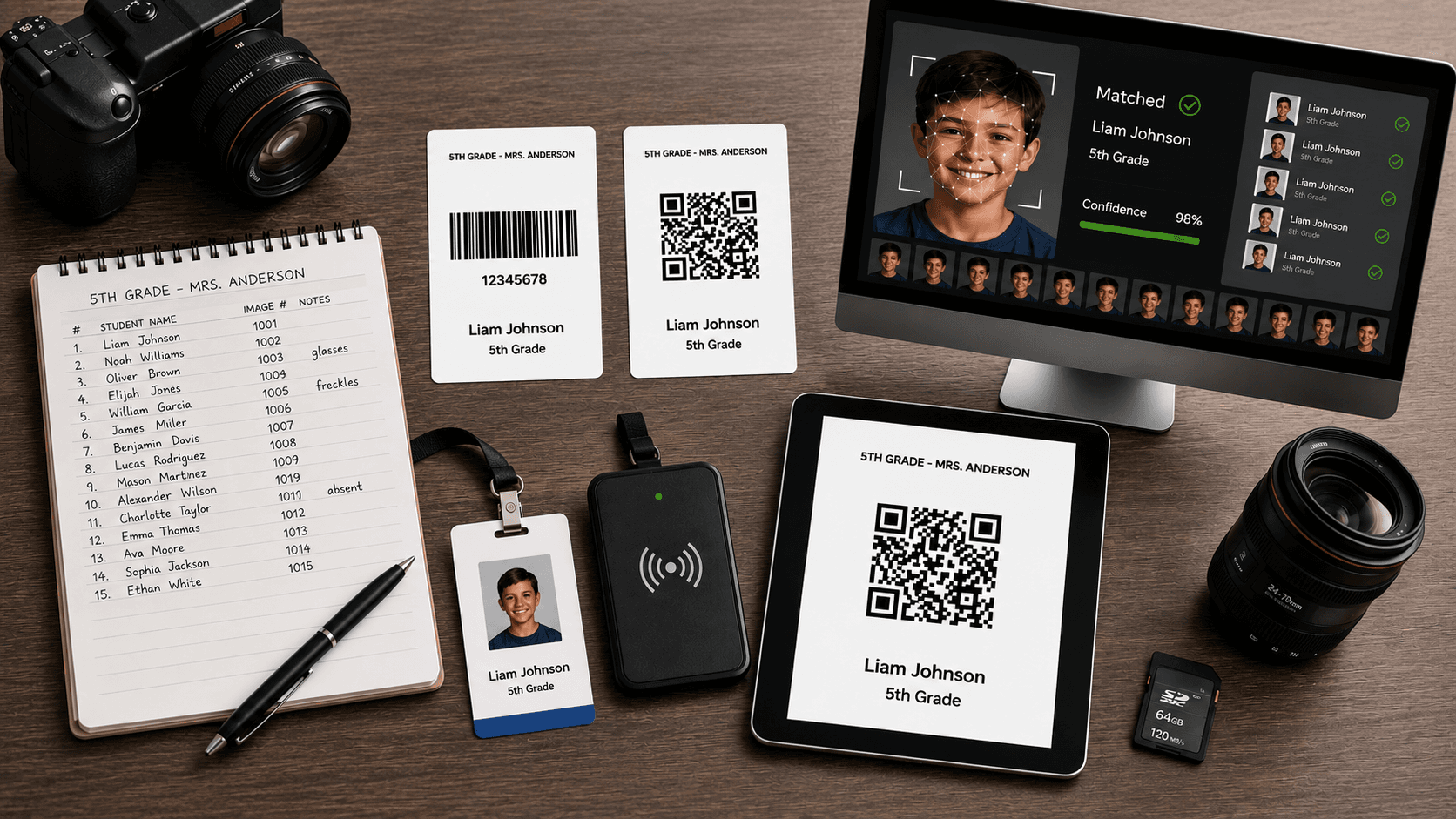
Before digital workflows became widespread, many photographers relied on handwritten notes, printed rosters, and manually recorded image numbers.
A common practice was to photograph a student and then write the image number directly on the student's order form or beside their name on a class roster. After picture day, those handwritten records would be used to manually match portraits to the correct students.
For photographers managing large schools, this process was extremely time-consuming and required careful review to avoid mistakes. While it could work for smaller jobs, it became increasingly difficult to manage as production volume grew.
This method eventually gave way to automated identification systems such as barcode cards, QR code camera cards, and other digital workflows that significantly reduced manual effort and improved accuracy.
As photography workflows became more automated, many organizations adopted barcode camera cards.
Each student receives a printed card containing a unique barcode that is photographed or scanned before the portrait session. Specialized workflow software later uses that identifier to associate the images with the correct student.
Although barcode systems remain in use, many photographers have transitioned to more modern two-dimensional code technologies.
Every successful picture day starts with one essential task: making sure every photo can be matched to the right student.
Today, QR code camera cards are among the most widely used identification methods in school photography.
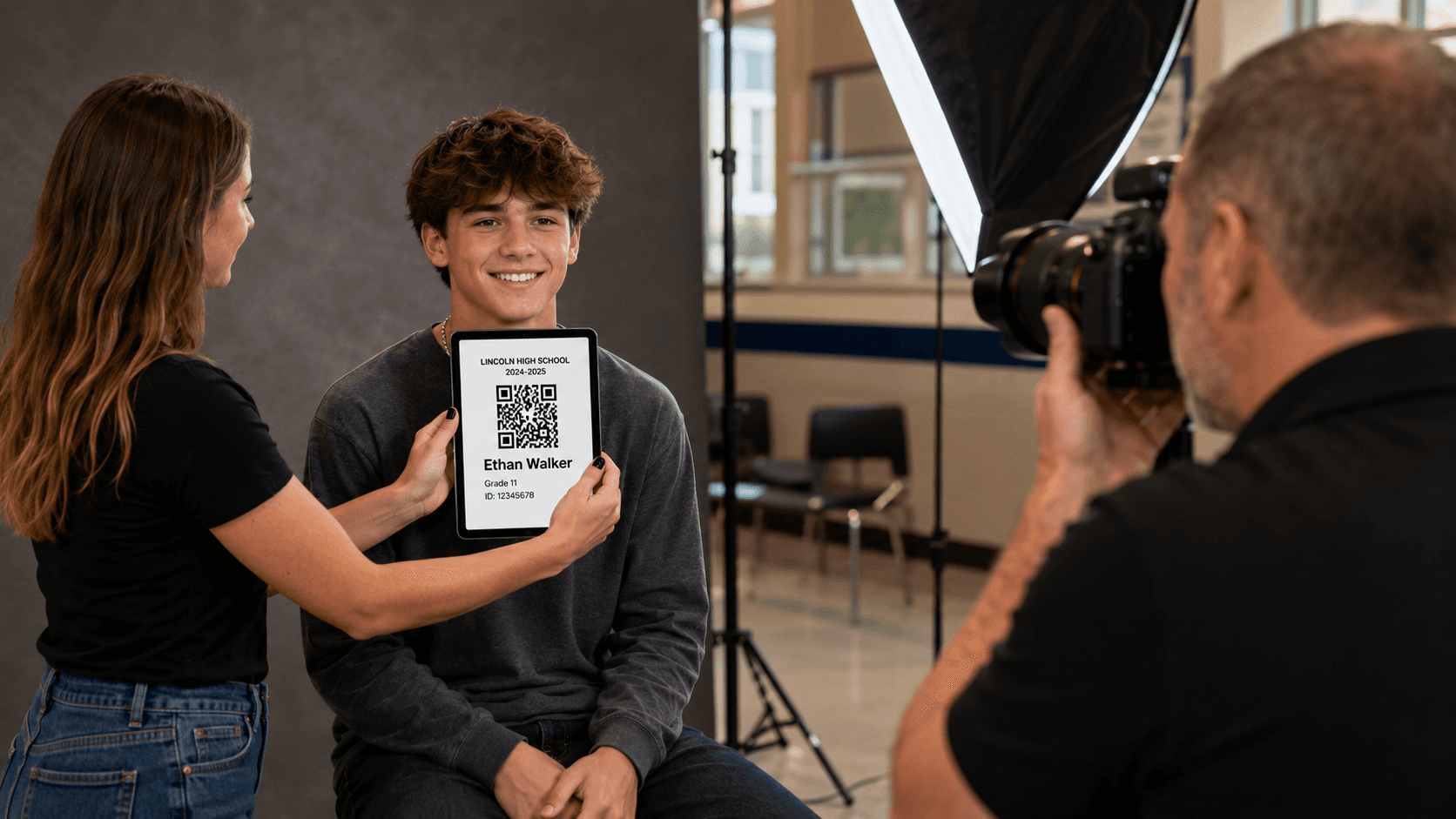
Each student is assigned a unique QR code that is photographed immediately before their portraits are taken to create a keyframe image. That image serves as a digital reference point that allows specialized workflow software to automatically match the following images with the correct student record.
QR code workflows reduce manual sorting, improve accuracy, and scale efficiently for high-volume operations.
While many QR code solutions require photographers to adopt an entirely new gallery and sales platform, some workflow tools integrate with existing systems instead. This enables studios to add QR code automation and modern identification capabilities without changing the gallery platform, storefront, or customer experience they already rely on.
To learn more about how QR code identification works in practice, see our guide on How Does QR Code Photography Work?
Recent advances in artificial intelligence have introduced facial recognition as another way to identify students.
Rather than relying on printed or digital camera cards, these systems analyze facial characteristics and compare them with known reference images.
Facial recognition can reduce manual work, but many photographers still prefer workflows that establish an explicit identification step before portraits are taken.
Many modern photography businesses combine multiple identification methods to maximize accuracy.
For example, a workflow might use QR code camera cards as the primary identification method while using facial recognition or manual review to verify matches and resolve exceptions.
By combining technologies, photographers can create flexible workflows that reduce errors while maintaining efficiency across large volumes of images.
Reliable identification is the foundation of every organized school photography workflow.
Although uncommon in school photography, some organizations have experimented with RFID (Radio Frequency Identification) and NFC (Near Field Communication) technologies to identify subjects or streamline event workflows.
Instead of photographing a printed code, RFID or NFC systems use electronic tags or chips that can be read wirelessly by compatible devices. These technologies are widely used in industries such as inventory management, access control, and event registration.
In school photography, however, RFID and NFC remain relatively rare. They typically require specialized hardware and infrastructure, making QR code workflows a more practical and cost-effective solution for most photography businesses.
These six methods represent different approaches to photo matching, but they're only one part of an end-to-end school photography workflow.
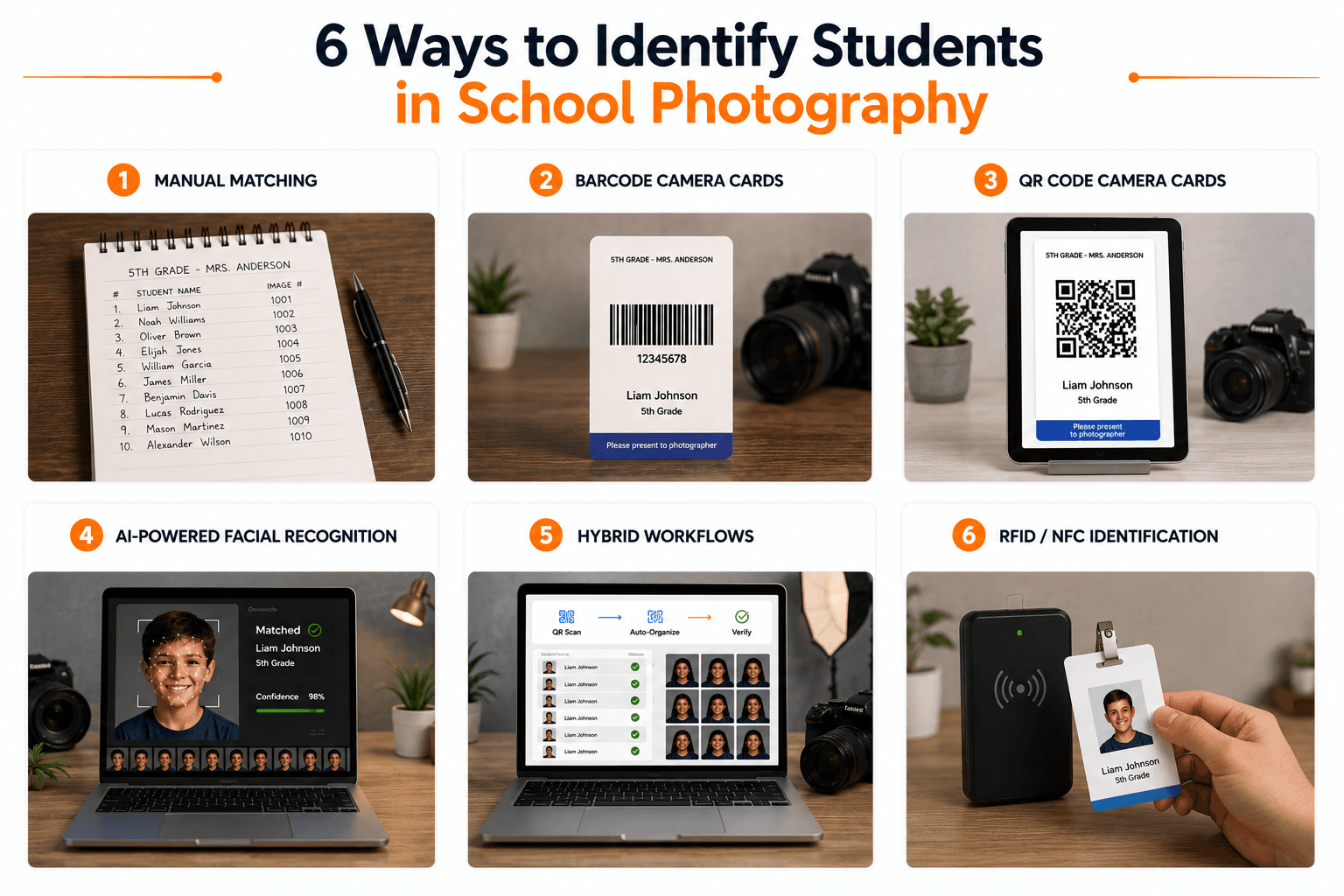
The best identification system depends on the photographer's workflow, equipment, and production volume.
For many high-volume operations, QR code workflows provide an effective balance of speed, reliability, and automation. Other organizations may supplement those workflows with facial recognition or additional verification steps to meet their specific needs.
Regardless of the method used, the objective remains the same: ensure every student receives the correct photos while minimizing manual effort.
Student identification has evolved significantly over the years, but the underlying goal has never changed.
Whether using handwritten notes, barcode cards, QR codes, facial recognition, RFID/NFC technology, or hybrid workflows, every identification method exists to solve the same problem: accurately connecting students with their portraits.
As technology continues to improve, automated workflows are helping photographers spend less time organizing images and more time delivering exceptional results to schools and families.
Related Articles
Explore more features, announcements, and workflow improvements.
Related Help Articles
Step-by-step guides and documentation from the Snapizzi Knowledge Base.
Continue Exploring Snapizzi
Content Directory — Browse all articles and workflow resources
Release History — Explore new features and product updates
Knowledge Base — Find tutorials and documentation
User Love — See what photographers say about Snapizzi